
Online dating should leave room for attraction without making your body public property. Safe dating apps for plus-size singles are best judged by enforceable conduct rules, accessible reporting, controlled visibility, and clear limits on what verification means—not by size-inclusive branding alone. No platform can promise a harassment-free experience, yet a careful protection audit can show whether an app gives you practical control when a match crosses a line.
Published by Match Pace
Signals that an app actively enforces rules against body-based harassment

Moderation becomes visible in the details. A credible app sets out prohibited conduct in plain language, with coverage that reaches body-shaming, degrading remarks, unwanted sexual content, and harassment—not merely a vague request to be respectful. Its reporting route should be reachable from both a profile and a live conversation, so a person does not have to keep engaging just to find help.
The strongest public signs are operational: distinct report categories, an explanation of what information a report can include, confirmation that a submission was received, and some account of possible moderation action or review. Policies do not need to reveal every internal method to be useful, but they should make clear that reports are more than a decorative menu item. If the only safety language is broad promotional copy and the report path is hard to locate, that is a meaningful gap.
What a verification badge proves—and what it cannot prove
- Verification Scope: A badge may show that an account completed the platform's stated verification process. The useful question is what that process actually checks, since platforms may use different inputs and standards.
- Identity Limit: It does not establish that every profile detail is accurate, that a person is being candid about their relationship status, or that their photos and messages reflect their real intentions.
- Behavior Limit: Verification cannot screen out fetishizing behavior, coercive sexual pressure, body-shaming, or someone who ignores a clearly stated boundary. Those are conduct issues, and they depend on effective moderation and reporting.
- Trust Limit: A verified account is not a measure of compatibility or offline trustworthiness. A match can have completed a platform check and still create discomfort in conversation.
- Audit Value: The app's official help material should explain the badge in enough detail to prevent false confidence. When that explanation is absent or unclear, the badge deserves less weight in the overall safety decision.
Privacy controls reduce exposure before trust is established
- Privacy Control: Hidden discovery, paused visibility, or limited profile visibility Protection Value: Reduces who can encounter a profile while you are deciding whether the app feels respectful and well managed. Constraint To Check: The settings should explain whether existing matches can still view or contact you.
- Privacy Control: Profile-level blocking Protection Value: Cuts off access from a match whose messages become degrading, sexual, or persistent. Constraint To Check: The block function should be easy to reach from the conversation and profile, without requiring contact with support first.
- Privacy Control: Location precision settings Protection Value: Keeps a profile from disclosing a highly specific home, workplace, or routine area before trust exists. Constraint To Check: Review whether the app displays an exact distance, a broad area, or no location detail.
- Privacy Control: Restricted photo albums or selective photo sharing Protection Value: Lets personal images remain unavailable until a match has earned more trust. Constraint To Check: Check who can request access and whether shared images can later be withdrawn.
- Privacy Control: Message initiation and filtering controls Protection Value: Can narrow unsolicited contact and make it easier to avoid messages that begin with sexual or body-focused remarks. Constraint To Check: The relevant setting should be understandable before you rely on it as a boundary.
Fetishization and boundary-testing warning patterns
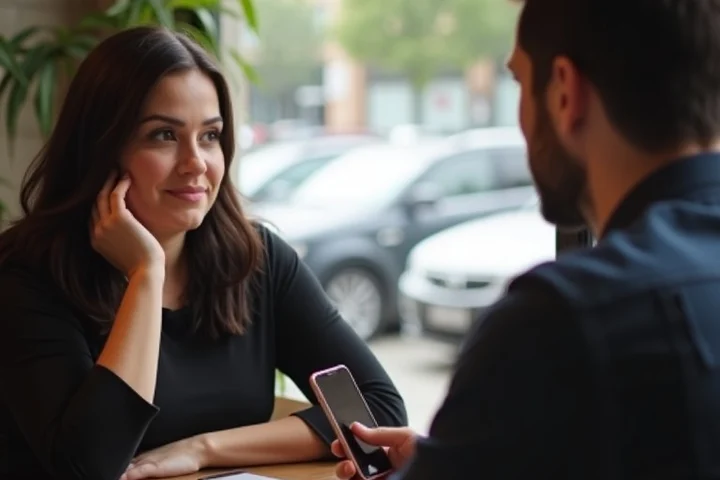
Attraction can be direct and still respectful. The warning pattern begins when body size becomes the entire subject: repeated comments about weight or shape, sexual assumptions tied to size, demands for particular photos, or praise that feels more like categorization than curiosity about a person. Secrecy requests deserve attention too, especially when someone wants the interaction hidden from their public dating life.
Boundary-testing often arrives in small escalations. A match brushes past your stated preferences, returns to the same sexual topic after you change it, or treats discomfort as flirtation. The pattern matters more than any one awkward opening line.
When a match turns body size into the entire conversation
A genuine conversation has room for your interests, values, humor, plans, and ordinary daily life. One clumsy comment can sometimes be redirected when the person responds with a real apology and changes the subject. A concise boundary leaves little room for confusion: "I’m interested in getting to know each other beyond comments about my body."
When the same person returns to the topic, pushes for body-specific photos, makes sexual remarks after a boundary, or becomes insulting, the exchange has stopped being a conversation worth repairing. Ending contact is appropriate. Slurs, degrading statements, unwanted sexual content, threats, or repeated pressure after a clear refusal also warrant an in-app report, even if you have already blocked the account.
Document, block, and report abusive behavior
- Preserve the relevant context before it disappears: the profile name, message thread, dates or times where visible, and the specific statements that show harassment or a boundary violation. Screenshots can supplement the in-app record.
- Open the report option from the profile or conversation and select the closest available category, such as harassment, hate or abusive conduct, unwanted sexual content, impersonation, or another clearly applicable option.
- Use the report description to state what happened plainly and identify the repeated behavior or explicit boundary violation. Relevant details are more useful than trying to explain away the person's intent.
- Block the account after the report is submitted, unless the app's process requires a different order. Blocking removes the immediate channel for further contact; it does not replace a report when the conduct merits review.
- Record any confirmation screen, case number, or support reference supplied by the platform. This creates a personal record if follow-up becomes necessary, without assuming a particular moderation outcome.
Inclusive marketing is not the same as enforceable protection
An inclusive landing page establishes that an app wants a particular audience to feel welcome; it does not, on its own, show how that audience is protected when mistreatment occurs. WooPlus presents itself as a platform for curvy and plus-size singles, which may make it relevant to a size-inclusive search. The practical next layer is its current community standards, reporting path, blocking tools, privacy settings, and explanation of what conduct can lead to action.
Mainstream services deserve the same scrutiny. Hinge provides an official safety resource, Tinder maintains a Safety Center, and Match publishes safety guidance. Those resources are useful places to inspect the protections each service describes, rather than treating a safety page as proof that every complaint will be resolved the same way. The better choice is the app whose official rules name the behavior you need addressed and whose controls are understandable before a problem starts.
The safest fit is rarely the app with the warmest message about inclusion. It is the one that lets you limit exposure, set a boundary without argument, and document harmful conduct through a reporting system that is visible before you need it.